
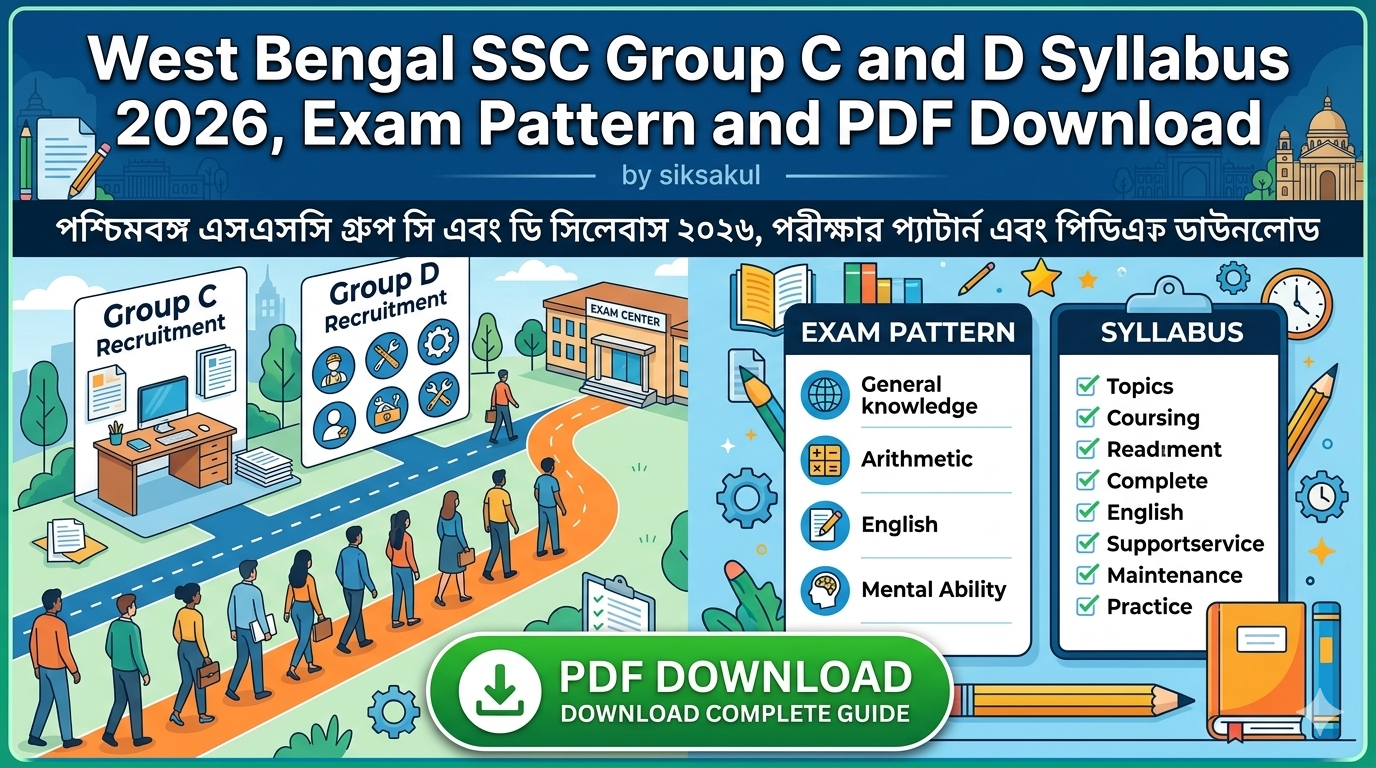
West Bengal SSC Group C and D Syllabus 2026: The West Bengal School Service Commission (WBSSC) has released the WBSSC Group C and D Syllabus 2026, which outlines the important subjects and topics that candidates need to prepare for the 1st State Level Selection Test (SLST) for Non-Teaching Staff. This syllabus helps applicants understand the exam structure and focus on the key areas required for the written examination.
For the Clerk (Group C) post, the syllabus generally includes subjects such as General Awareness, General English, Logical Reasoning, and Arithmetic. These sections are designed to test the candidate’s basic knowledge, language ability, reasoning skills, and numerical aptitude.
On the other hand, the Group-D Staff written examination mainly consists of General Awareness, Logical Reasoning, and Arithmetic. Candidates preparing for this post should focus on strengthening their general knowledge, problem-solving skills, and basic mathematical concepts to perform well in the exam.
West Bengal SSC Group C and D Syllabus 2026, Exam Pattern and PDF Download
Table of Contents
WBSSC Group C and D Syllabus 2026 and Exam Pattern
The WBSSC Group C and D Syllabus 2026 along with the exam pattern helps candidates understand the subjects, marking scheme, and difficulty level of the examination. By reviewing the syllabus and pattern carefully, applicants can focus on the most important topics and prepare effectively for the 1st State Level Selection Test (SLST) for Non-Teaching Staff scheduled in March 2026.
The recruitment process is conducted by the West Bengal Central School Service Commission (WBSSC). The overview of the syllabus and exam pattern for Group C (Clerk) and Group D Staff posts is given below.
| Particulars | Group C – Clerk | Group D – Staff |
|---|---|---|
| Organisation | West Bengal Central School Service Commission (WBSSC) | West Bengal Central School Service Commission (WBSSC) |
| Exam Name | WBSSC Group C (Clerk) 2026 | WBSSC Group D 2026 |
| Category | Syllabus | Syllabus |
| Post Name | Clerk (Group C) | Group-D Staff |
| Subjects | General Awareness, General English, Logical Reasoning, Arithmetic | General Awareness, Logical Reasoning, Arithmetic |
| Mode of Exam | Offline (Objective Type) | Offline (Objective Type) |
| Total Marks | 60 | 40 |
| Question Level | Class 10th Standard | Class 8th Standard |
| Selection Process | Written Examination | Written Examination |
WBSSC Group C Exam Pattern 2026 (Clerk)
The written examination for the Clerk (Group C) post conducted by the West Bengal Central School Service Commission (WBSSC) consists of multiple-choice questions (MCQs). The exam includes 60 questions carrying a total of 60 marks.
The question paper is divided into four major sections, each designed to test the candidate’s knowledge, language skills, reasoning ability, and numerical aptitude.
| Subject | Marks |
|---|---|
| General Awareness | 20 |
| General English | 10 |
| Logical Reasoning | 10 |
| Arithmetic | 20 |
| Total | 60 |
WBSSC Group D Exam Pattern 2026
The written examination for the Group-D Staff post conducted by the West Bengal Central School Service Commission (WBSSC) will consist of objective-type multiple-choice questions (MCQs). The exam includes 40 questions carrying a total of 40 marks.
The question paper is divided into three main sections, focusing on the candidate’s general knowledge, reasoning ability, and basic mathematical skills.
| Subject | Marks |
|---|---|
| General Awareness | 20 |
| Logical Reasoning | 10 |
| Arithmetic | 10 |
| Total | 40 |
WBSSC Group C Syllabus 2026 (Clerk)
The WBSSC Group C Syllabus 2026 for the Clerk (Group C) post conducted by the West Bengal Central School Service Commission (WBSSC) includes four major subjects: General Awareness, General English, Logical Reasoning, and Arithmetic. These sections are designed to evaluate a candidate’s general knowledge, language skills, analytical thinking, and basic mathematical ability, which are essential for clerical responsibilities.
Part A – General Awareness (20 Marks)
This section aims to assess the candidate’s awareness of current events and basic general knowledge related to India and the world. The important topics include:
- Indian History and Geography: Important historical events, national movements, and major geographical features of India.
- Indian Constitution: Fundamental Rights, Fundamental Duties, and the basic structure of the Indian governance system.
- Education: Basic knowledge about the National Education Policy (NEP) at the school level and the education system in West Bengal.
- Social Awareness: Gender awareness and knowledge of important rules and regulations related to society.
- Culture: Basic understanding of traditional as well as modern popular culture of India.
- Computer Knowledge: Basic computer fundamentals, common terminology, and everyday computer usage.
- General Science: Awareness about the environment, scientific innovations, and major inventions.
- Current Affairs: Recent economic developments and major achievements in sports and other important fields.
Part B – General English (10 Marks)
This section tests the candidate’s basic English language skills, including grammar, vocabulary, and sentence formation. The questions are designed to assess the ability to understand and use the English language correctly.
Key topics include:
- Grammar: Correct usage of prepositions, singular and plural forms, and basic grammatical rules.
- Vocabulary: Synonyms, antonyms, and meanings of common words.
- Language Skills: Spelling correction, sentence structure, and basic comprehension.
Part C – Logical Reasoning (10 Marks)
The Logical Reasoning section evaluates the candidate’s analytical thinking, reasoning ability, and problem-solving skills. Questions in this section focus on identifying patterns, relationships, and logical connections.
Important topics include:
- Series and Sequences: Identification of pictorial or number series and sequences.
- Classification: Finding the odd one out from a group of related words or objects.
- Analytical Reasoning: Propositions (True/False), matching problems, and simple logical puzzles.
This section is part of the WBSSC Group C Clerk examination conducted by the West Bengal Central School Service Commission (WBSSC).
Part D – Arithmetic (20 Marks)
Questions in this section will be based on fundamental mathematical concepts up to the Class 10 standard.
- Number Theory: LCM, HCF, Fractions, Simplifications.
- Ratio and Proportion: Percentages, Averages, Simple Interest.
- Commercial Maths: Profit and Loss.
- Time and Work: Time, Work, and Distance.
Download Official WBSSC Group C Syllabus Here
Group D Syllabus 2026
The WBSSC Group D Syllabus 2026 is designed to test foundational knowledge and basic skills. It covers three main subjects: General Awareness, Logical Reasoning, and Arithmetic, with all questions set to the Class 8 standard.
Part A – General Awareness (20 Marks)
This section evaluates the candidate’s basic awareness about India, West Bengal, and current events. The key topics include:
- History and Geography: Basic knowledge of Indian History and Geography.
- Indian Constitution: Elementary understanding of the Indian Constitution.
- Regional Culture: Basic knowledge of traditional and contemporary popular culture of West Bengal.
- Current Affairs: Recent sports achievements and major events in India.
- Computer Literacy: Basic computer knowledge and elementary computer literacy.
Part B – Logical Reasoning (10 Marks)
This section tests the candidate’s basic reasoning and analytical ability through simple questions.
Important topics include:
- Series and Sequences: Identification of pictorial series and sequences.
- Classification: Grouping words and identifying the odd one out.
- Analytical Reasoning: True/False propositions and matching-type questions.
- Relationships: Simple blood relation problems.
Part C – Arithmetic (10 Marks)
This section evaluates the candidate’s basic mathematical skills based on the Class 8 standard syllabus. Questions are designed to test fundamental numerical ability and simple problem-solving techniques.
Key topics included in this section are:
- Basic Concepts: Problems related to Average, Percentage, Ratio, and Proportion.
- Number System: Simple questions based on LCM (Least Common Multiple) and HCF (Highest Common Factor).
- Interest: Basic numerical problems related to Simple Interest.
This section is part of the WBSSC Group D written examination conducted by the West Bengal Central School Service Commission (WBSSC).
Download Official Group D Syllabus Here
FAQs – WBSSC Group C and D Syllabus 2026
Q1. What is the syllabus for WBSSC Group C and D Exam 2026?
The West Bengal School Service Commission (WBSSC) Group C and D syllabus generally includes subjects such as General Knowledge, English, Mathematics, and Reasoning. The detailed subject-wise syllabus is provided in the official notification.
Q2. What is the exam pattern for WBSSC Group C and D 2026?
The WBSSC Group C and D exam pattern usually consists of an objective-type written examination with multiple-choice questions (MCQs). The exam may include sections like General Awareness, Arithmetic, English, and Reasoning, followed by document verification or other stages as specified by the Commission.
Q3. Where can I download the WBSSC Group C and D Syllabus 2026 PDF?
Candidates can download the WBSSC Group C and D Syllabus 2026 PDF from the official website of the West Bengal School Service Commission or from trusted educational portals that provide the direct download link.
Q4. Is the WBSSC Group C and D exam conducted online or offline?
Generally, the WBSSC Group C and D written exam is conducted offline (OMR-based), but candidates should check the latest notification for confirmation.
Q5. What subjects should I focus on for WBSSC Group C and D preparation?
For better preparation, candidates should focus on General Knowledge, Current Affairs, Basic Mathematics, English Language, and Logical Reasoning.
Q6. Is there negative marking in the WBSSC Group C and D exam?
Negative marking depends on the official recruitment notification released by the West Bengal School Service Commission. Candidates are advised to check the latest exam guidelines.
Q7. Who can apply for WBSSC Group C and D recruitment?
Candidates who have completed minimum 8th pass, 10th pass, or equivalent qualification (depending on the specific post) are generally eligible to apply for WBSSC Group C and D posts, as mentioned in the official notification.
Q8. How can I prepare effectively for WBSSC Group C and D Exam 2026?
Candidates should follow the latest syllabus, practice previous year question papers, solve mock tests regularly, and stay updated with current affairs to improve their chances of success in the exam.
